
Blog
NABH and NABL: the records your hospital software has to produce
Accreditation rarely fails on clinical practice. It fails on being unable to produce the record of it.
7 min read
NABH accredits hospitals; NABL accredits testing laboratories. Both are, from the software's point of view, the same kind of demand: prove what you did, when, by whom, and show that you can produce that proof consistently rather than for the week of the assessment.
A hospital preparing for either usually discovers that the clinical practice is fine and the record of it is scattered. That is a software problem, and it is worth being specific about which parts.
The laboratory side
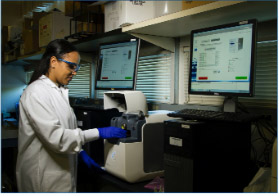
A laboratory has to show a chain: the test was ordered, a sample was collected and identified, it was run, a result was entered, and a report went out in a defined format. Where any link is on paper or in someone's memory, the chain is only as good as that person's day.
The laboratory module keeps that chain in one place — test creation and result entry, sample collection, re-test status, turnaround time, analyser integration through LIS, and report formats kept in the shape NABL documentation asks for. The section-wise split across biochemistry, pathology, microbiology and haematology is part of it, because a laboratory is assessed section by section.
The records side
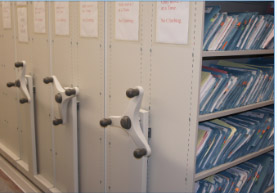
The hospital-wide equivalent is the medical record: can you find a patient's file, do you know where it physically is, and does the clinical summary carry coded diagnoses rather than free text?
- Files tracked from issue through movement to return, so a missing file is a question with an answer.
- Barcode labelling, so tracking does not depend on handwriting.
- Discharge summaries carrying ICD-10 codes, so cases are searchable as a class rather than one at a time.
- Lab and scan reports attached to the same patient record as the notes.
Those live in medical records and the doctor module respectively, and both read from the same patient number described in our post on what a UHID is.
What software cannot do for you
It is worth being honest about the boundary. Accreditation covers policy, training, infection control, patient rights, safety drills and a great deal else that no system produces. Software gets you the documentation half — reliably and without a fortnight of preparation — and that is all it gets you.
Any vendor who tells you their product makes a hospital NABH-accredited is describing something that does not exist. What a good system does is make sure that when the assessor asks for the record, someone can produce it in a minute rather than a morning.
A reasonable checklist
- Can you produce every result issued for a given patient, in date order, today?
- Can you show which samples were re-tested and why?
- Do you know where any physical file is right now?
- Are discharge summaries coded, or written?
- Does the report format come out of the system, or does someone format it?
If more than one of those is a no, the gap is in the record rather than the practice. The features page lists what TechMediz covers across the hospital.
See it on a live system
Tell us which departments you need first and we will show you the modules that cover them — Mescope Solutions, Salem.
The modules behind this

Keep reading
Implementing hospital software without stopping the hospital
The software is rarely why an implementation fails. The sequence, the data and the second week are.
Bed management: knowing which bed is free before the phone rings
A bed occupied by a patient who left at nine is a bed the hospital cannot sell and cannot admit into. Occupancy is a discharge problem before it is a capacity problem.
How a hospital bill is actually assembled
The out-patient bill is a transaction. The in-patient bill is an accumulation — and everything that goes wrong with hospital billing goes wrong in that gap.